Tamil Nadu Erupts: DMK and Allies Lead Widespread Protests Against Special Investment Regions (SIR)
Across Tamil Nadu, the ruling DMK and its allies have launched widespread demonstrations, voicing strong opposition to the proposed Special Investment Regions (SIRs), reigniting crucial debates on industrial development, land rights, and federal autonomy.
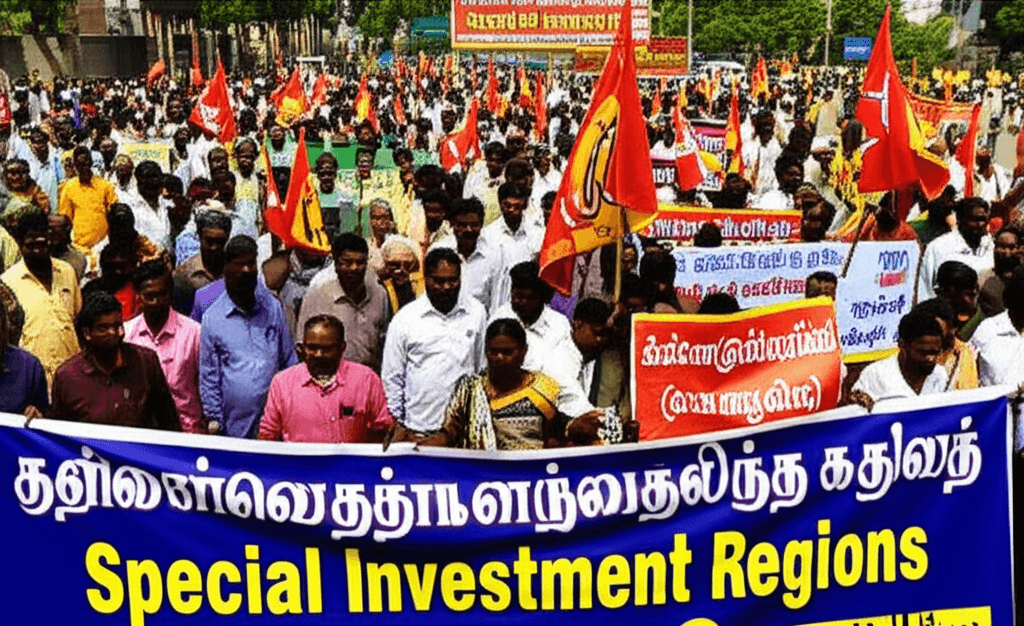
A State United in Protest: The Standoff Against SIR
In a powerful display of political unity and public mobilization, Tamil Nadu is currently witnessing widespread demonstrations led by the Dravida Munnetra Kazhagam (DMK), the state's ruling party, and its various allies. These protests are specifically aimed at opposing the implementation of what are known as Special Investment Regions (SIRs). From bustling urban centers to quieter rural villages, the protests reflect a growing sentiment of concern and resistance against a development model that many fear could have profound social, economic, and environmental ramifications for the state.
The demonstrations aren't just a political spectacle; they represent a critical juncture in Tamil Nadu’s ongoing conversation about development priorities. The core of the opposition stems from fears regarding large-scale land acquisition, the potential displacement of agrarian communities, environmental degradation, and concerns over the erosion of local autonomy. For the DMK and its coalition partners, this isn't merely about blocking industrial progress; it's about safeguarding the livelihoods of millions and protecting the ecological balance of a state deeply rooted in both agriculture and a vibrant natural landscape.
Unpacking the SIR Concept: A National Overview of Special Investment Regions
So, what exactly are Special Investment Regions (SIRs) and why are they stirring such fervent opposition in Tamil Nadu? At their heart, SIRs are envisioned as large, contiguous areas designated by state governments, often with central government backing, to promote rapid industrial and economic development. The idea is to create world-class industrial hubs by providing robust infrastructure, streamlined regulatory processes, and attractive incentives for investors, both domestic and international.
The concept isn't entirely new to India. States like Gujarat have already enacted legislation, such as the Gujarat Special Investment Region Act, 2009, to facilitate the creation and governance of such zones. The primary objectives typically include:
- Attracting Large-Scale Investments: Creating an investor-friendly environment to draw significant capital into manufacturing, technology, and other key sectors.
- Job Creation: Generating employment opportunities, especially for the youth, through the establishment of new industries.
- Infrastructure Development: Building state-of-the-art physical infrastructure, including roads, power, water supply, and waste management systems, often in greenfield areas.
- Economic Growth: Boosting the state's GDP and overall economic output through industrialization and exports.
- Single-Window Clearance: Simplifying bureaucratic procedures to ensure quick approvals and clearances for businesses, reducing red tape.
While the economic rationale behind SIRs is often articulated as fostering growth and competitiveness, the implementation frequently sparks contention. The significant land requirements, the need for vast resources, and the often top-down planning approach can collide with local interests and established ways of life. This creates a recurring 'development vs. displacement' dilemma, a narrative that has played out in various forms across India for decades whenever large infrastructure or industrial projects are proposed.
The Core of the Opposition: Why Tamil Nadu Says No to SIR
The protests led by the DMK and its allies are multifaceted, reflecting a deep-seated apprehension about how SIRs might fundamentally alter Tamil Nadu's socio-economic fabric. Their concerns can be broadly categorized into several critical areas:
1. Land Acquisition and Farmer Dispossession
Perhaps the most potent point of contention revolves around land. Tamil Nadu, a state with a significant agricultural base, views large-scale land acquisition with extreme caution. Farmers and advocacy groups fear that the establishment of SIRs will inevitably lead to:
- Forced Acquisition: Concerns that agricultural lands, including fertile farmlands and those vital for food security, will be acquired under eminent domain, potentially without adequate consent or fair compensation.
- Inadequate Compensation: Historical precedents in India often show that compensation packages, while seemingly substantial, may not truly reflect the long-term economic value of land or the cost of rebuilding livelihoods.
- Displacement of Agrarian Communities: Thousands of farming families could face displacement, losing not just their land but their generational connection to it and their primary source of income.
The state has a history of robust farmer movements, and the prospect of losing ancestral lands to industrial parks resonates deeply within these communities. Policies aimed at farmer welfare, such as the PM-KISAN Yojana, highlight the importance of agricultural income, making large-scale land acquisition a particularly sensitive issue.
2. Environmental Impact and Resource Depletion
Beyond land, the environmental implications of SIRs are a major red flag for the protesting parties and environmental activists. Large industrial zones, by their very nature, are often associated with:
- Pollution: Increased air and water pollution from factories, leading to health hazards for local populations and degradation of natural ecosystems.
- Water Scarcity: Industries are typically heavy consumers of water, potentially exacerbating water scarcity issues in a state already prone to water stress in many regions. This could divert water resources away from agriculture and domestic use.
- Loss of Biodiversity: The clearing of land for industrial development can lead to the destruction of natural habitats, wetlands, and forests, impacting local flora and fauna.
- Climate Change Vulnerability: Rapid, unregulated industrialization can contribute to greenhouse gas emissions, making the region more vulnerable to the impacts of climate change.
These concerns underscore a broader debate on balancing economic growth with ecological sustainability, a challenge that many developing regions grapple with.
3. Livelihood Disruption and Social Displacement
While SIRs promise new jobs, the DMK and its allies argue that these opportunities often don't align with the skills of displaced rural populations. This mismatch can lead to:
- Skill Gap: Agricultural workers may not possess the specialized skills required by modern industries, leading to underemployment or continued unemployment.
- Loss of Traditional Livelihoods: Beyond farming, communities often depend on allied activities like livestock rearing, fishing, and artisanal crafts, all of which can be disrupted by large-scale industrialization.
- Social Dislocation: Displacement can break down community structures, cultural practices, and social support networks, leading to significant psychological and social challenges for affected populations.
The protests emphasize that 'development' must be inclusive and sensitive to the existing social fabric, rather than imposing a model that leaves large segments of the population marginalized.
4. Federalism and State Autonomy: A Deeper Political Current
Underpinning many of the objections is a strong assertion of federal principles. The DMK, a regional party with a long history of advocating for state rights, views certain aspects of SIR proposals as a potential infringement on Tamil Nadu's autonomy. The concerns here include:
- Central Government Influence: Apprehensions that centrally-driven industrial policies or a uniform SIR framework might bypass state-specific needs and priorities.
- Control Over Resources: Debates over who has ultimate control over land, water, and other natural resources within these zones, and whether state powers might be diluted.
- Legislative Discrepancies: Potential conflicts between state laws governing land use, environmental protection, and labor, and the special regulations proposed for SIRs.
This adds a significant political dimension to the protests, positioning them as part of a larger struggle for the preservation of states' rights within the Indian federal structure. For more insights into such political dynamics, one might explore various discussions on the category of Politics.
DMK and its Allies: The Voices Leading the Charge
The current wave of demonstrations is not a spontaneous eruption but a carefully orchestrated effort by a broad coalition. Chief Minister M.K. Stalin, a prominent figure in regional politics, has been vocal in his administration's stance. While specific quotes from this particular wave of protests might emerge in real-time news, the DMK's historical position has always been to champion the cause of farmers and local communities, especially against perceived injustices in land acquisition and resource exploitation.
The DMK’s allies, which typically include the Indian National Congress, the Communist Party of India (Marxist), the Communist Party of India, the Viduthalai Chiruthaigal Katchi (VCK), and the Marumalarchi Dravida Munnetra Kazhagam (MDMK), among others, have joined forces, amplifying the message. Their collective strength allows for widespread mobilization, ensuring that the protests are not confined to a single locality but spread across various districts, ensuring maximum visibility and pressure on policymakers.
"Our stand is clear: development cannot come at the cost of our farmers, our environment, and our basic rights. We will not allow the creation of industrial zones that displace our people and degrade our land without their consent and fair consideration," a senior DMK leader was quoted saying in local media, reflecting the party's firm resolve.
Farmers' associations and various civil society organizations are also integral to these protests, providing ground-level support and adding an authentic voice to the movement. Their participation highlights that the opposition isn't just political; it's a genuine grassroots concern.
The Government's Counterpoint: Promises of Progress
While the protests articulate strong opposition, the proponents of SIRs, often the central government and segments of the business community, emphasize a different narrative. Their vision for Special Investment Regions typically centers on:
- Economic Development: SIRs are seen as crucial engines for accelerating industrial growth, diversifying the economic base, and making India (and states like Tamil Nadu) more competitive globally.
- Job Creation: The promise of millions of direct and indirect jobs for a young and growing workforce is a significant argument, aiming to address unemployment and underemployment.
- Attracting FDI: Providing a stable, efficient, and incentivized environment is expected to attract significant Foreign Direct Investment, bringing in capital, technology, and global best practices.
- World-Class Infrastructure: The development of dedicated infrastructure within SIRs is touted as a way to overcome existing logistical bottlenecks and provide a conducive environment for high-tech manufacturing and other industries.
The argument is that without such ambitious projects, states risk falling behind in the global race for investment and economic prosperity. The challenge, then, lies in finding a balance between these lofty economic aspirations and the very real concerns of the local populace.
Past Precedents and the Ongoing Balancing Act
The debate around SIRs is not isolated. India has a long history of grappling with the consequences of large-scale development projects. The Special Economic Zones (SEZ) Act of 2005, for instance, also aimed to create export-oriented industrial hubs. While some SEZs have been successful, others have faced similar challenges related to land acquisition, environmental impact, and benefits accruing primarily to corporations rather than local communities.
This historical context informs the current skepticism. Policymakers and protestors alike are acutely aware of the complexities involved in such projects, where the promised benefits often take time to materialize, and the immediate costs, especially for vulnerable populations, are often borne disproportionately. The balancing act between fostering industrial growth and ensuring inclusive, sustainable development remains one of the most significant policy challenges in India.
The Road Ahead: A Critical Juncture for Tamil Nadu
As the protests continue across Tamil Nadu, several potential outcomes and developments are on the horizon. The sustained pressure from the DMK and its allies could lead to:
- Policy Review: The state government might be compelled to reconsider or significantly modify its approach to SIRs, potentially seeking more localized, consultative models of development.
- Intensified Dialogue: The protests could force a more direct and transparent dialogue between policymakers, industrial bodies, and affected communities, aiming for mutually agreeable solutions.
- Legal Challenges: Should land acquisition proceed aggressively, legal challenges from affected communities or environmental groups are highly probable, potentially delaying or halting projects.
- Political Ramifications: With general elections often looming, the handling of such sensitive issues can have significant political consequences, impacting voter sentiment and future electoral outcomes.
The situation in Tamil Nadu highlights a crucial democratic process where citizens and their elected representatives voice their concerns against policies perceived as detrimental. It’s a powerful reminder that economic development, to be truly sustainable, must be built on a foundation of social equity, environmental responsibility, and genuine public consent.
Conclusion: Navigating Development with Empathy and Foresight
The widespread demonstrations across Tamil Nadu opposing Special Investment Regions are more than just political theater; they are a profound expression of a community’s anxieties about its future. The DMK and its allies are articulating concerns that resonate deeply with many: the protection of agricultural land, the preservation of the environment, the safeguarding of livelihoods, and the assertion of state autonomy.
While the vision for SIRs holds the promise of significant economic upliftment and job creation, the path to achieving these goals must be paved with careful consideration for the human and ecological costs. The protests serve as a vital call for an approach to development that is not only economically robust but also socially just, environmentally conscious, and democratically accountable. How Tamil Nadu navigates this complex issue will set an important precedent for balancing industrial ambition with community well-being, defining its trajectory for years to come.
Comments
Loading comments...
Related Articles

Olivia Nuzzi's 'American Canto': A Deep Dive into Her Highly Anticipated New Book
Political journalist Olivia Nuzzi is set to captivate readers with her new book, 'American Canto,' promising an unfiltered, deeply immersive journey into the heart of contemporary American politics. This article explores Nuzzi's distinctive voice, her career trajectory, and the profound themes readers can expect from her latest literary endeavor.